“Never Let Me Go” as a motif
Never Let Me Go“Never Let Me Go” is the song at the center of a private fantasy that later becomes one of Kathy’s most unsettling memories. Its imagined mother and baby give Kathy a way to feel the longing and fear of separation, while her encounter with Madame turns that intimate daydream into a scene whose meaning she can understand only years afterward.
The song and Kathy’s private ritual
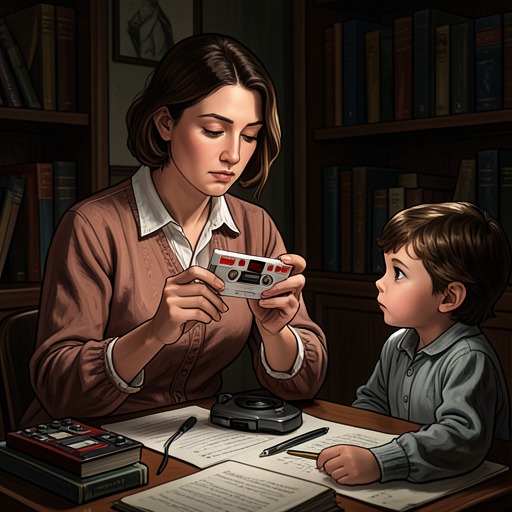
Kathy’s attachment is not to Judy Bridgewater’s style or to the cigarette pictured on the cassette cover. She explains that the tape mattered because of its third track, “Never Let Me Go.” At eleven, she repeatedly wound the cassette back to that passage, saving the song for chances to listen alone. Its slow, late-night American sound was not the kind of music the students at Hailsham generally liked, but that did not diminish its importance to her.
Listening privately required some planning. There were players in the billiards room and the Art Room, but both spaces were usually noisy. Kathy’s reliable refuge was the dormitory in one of the separate huts, where a portable cassette player sat on a shelf above the radiator in a small six-bed room. She went there when nobody else was likely to be around and played the same song repeatedly. The routine makes the song less a shared cultural object than a deliberately protected space for a feeling Kathy could not otherwise express.
The imagined mother and child
Kathy did not attend closely to the song’s full lyrics. She waited for its recurring plea and imagined a woman who had been told she could not have children, had wanted one all her life, and then, by a miracle, had a baby. In Kathy’s version, the mother holds the child close and sings partly from happiness and partly from fear that the baby might fall ill or be taken away. The fantasy gives the song an emotional story of attachment threatened by loss.
Even as a child, Kathy knew that her interpretation did not fit the rest of the lyrics. She accepted the mismatch rather than correcting it: what mattered was the scene she had made from the refrain. That distinction is central to the motif. The song does not literally tell Kathy’s story, and she does not claim that it does; instead, her selective listening lets her inhabit a mother’s imagined fear of losing a child. The fantasy is especially poignant because Kathy and the other students would later be told plainly that they could not have babies, although at the time of the dormitory incident Kathy did not properly know this.
Madame sees the fantasy
One sunny afternoon, alone in the dorm, Kathy impulsively put on the tape. She swayed slowly with her eyes closed, holding a pillow as if it were a baby and singing softly when the refrain came around. The scene was so private that Kathy had not meant anyone to see it. When the song was nearly over, she opened her eyes and found Madame watching from the corridor.
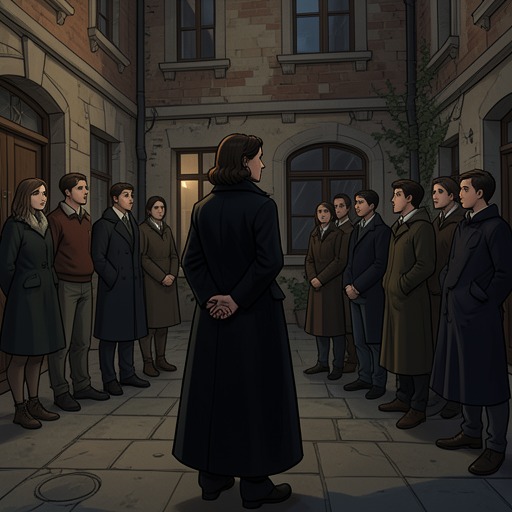
Madame had not come to the threshold. The dorm door stood almost halfway open, as dorm doors were not supposed to be shut completely except at night, and she remained outside, still and angled toward the room. She was crying. Kathy expected an adult to tell her off or otherwise explain what to do, but Madame did neither: she turned away and hurried toward the main house, still sobbing. Kathy switched off the tape and sat down. She later kept the incident to herself, wishing it had not happened and thinking that silence might spare both herself and her friends from its discomfort.
The tableau brings Kathy’s private image into contact with an adult’s distress without explaining that distress at once. The pillow and the imagined baby are meaningful to Kathy, but she cannot know what Madame has understood, if anything. Madame’s tears and departure therefore leave the scene suspended between a child’s private fantasy and a response whose cause remains out of reach. The moment becomes more troubling in retrospect precisely because Kathy initially has no explanation for it.
Tommy’s later explanation and the motif’s afterlife
Kathy eventually told Tommy about the encounter, a couple of years later, during the period when they had begun asking questions about themselves and Tommy had confided in her about Miss Lucy. By then, the students had been told clearly that they could not have babies. Kathy considered whether she might have sensed this fact earlier without fully understanding it, but she did not believe she had known it properly when she first listened to the song. The later knowledge changes the remembered scene without making the child’s original understanding fully conscious.
Tommy offered a compassionate explanation: Madame may have seen Kathy holding her imagined baby and found the thought of her inability to have children tragic. Kathy immediately tested that account. She asked how Madame could have known what the song meant to her or that the pillow represented a baby, since both meanings existed only in Kathy’s mind. Tommy then suggested, only half jokingly, that Madame might be able to read minds. His speculation registers their uncertainty; it does not settle what Madame knew or why she cried.
The motif consequently works through delayed recognition rather than a confirmed revelation. At first, the song belongs to Kathy’s secluded childhood ritual; later, her memory of Madame’s tears acquires a possible connection to the students’ inability to have children. The gap between Kathy’s inward meaning and Madame’s unexplained reaction remains intact. The song’s imagined plea to keep a child close thus carries both the comfort Kathy found in it and the fear of separation that her later knowledge makes impossible to ignore.